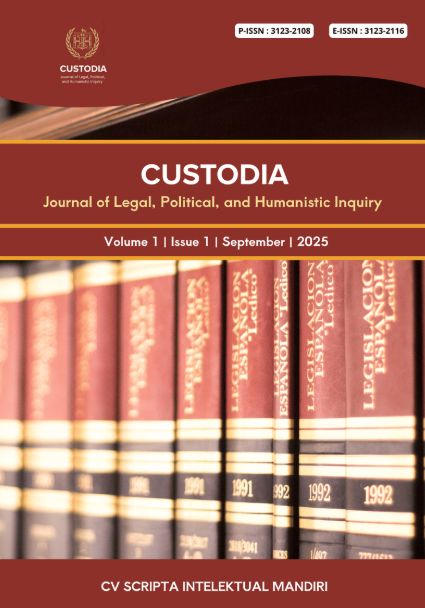
Reconstruction of Alimony Obligations in the Household: A Normative Legal Analysis of the Role of the Wife as Breadwinner in Islamic Law
DOI:
https://doi.org/10.65310/enkyvd32Keywords:
Maintenance Obligations, Role of the Wife, Family Harmony, Islamic Law, Household.Abstract
This study discusses the Islamic legal perspective on the role of wives as breadwinners, based on the fact that the obligation to provide for the family, which should be the responsibility of the husband, often falls to the wife. To date, many wives play a role in helping their husbands to meet the family's economic needs, and some wives even become the main breadwinners. This study uses a normative juridical approach with a descriptive qualitative research design. Data collection techniques were carried out by examining various relevant literature such as the Qur'an, Hadith, fiqh books, Islamic law books, and scientific journals discussing the Islamic legal perspective on the role of wives as breadwinners. Data analysis was conducted using content analysis, which involved systematically interpreting the content of the source material through a process of categorization and meaning extraction. In Islamic law, providing for the family is the primary obligation of the husband, but economic, social, and cultural conditions often require wives to work to help support the family. This dual role of wives can strengthen household finances, but it can also cause tension and role conflicts. Therefore, balance and mutual understanding are important to maintain harmony.
Downloads
References
Alfiati, L., & Mahmudah, U. (2020). Peran ganda perempuan dalam keharmonisan rumah tangga: Studi kasus di Desa Ngabar Kecamatan Siman Kabupaten Ponorogo. Ngabari: Jurnal Studi Islam dan Sosial, 13(1), 54-73. https://doi.org/10.51772/njsis.v13i1.50.
Al-Qur’an. “Surah Al-Baqarah Ayat 233”. Departemen Agama Republik Indonesia. Accessed October 19, 2025. https://quran.kemenag.go.id/quran/per-ayat/surah/2?from=233&to=233.
Halim, A. (2022). Istri Sebagai Pencari Nafkah Dalam Keluarga Ditinjau Dari Hukum Islam Di Desa Pace Kabupaten Jember Jawa Timur Indonesia. El-Bait: Jurnal Hukum Keluarga Islam, 1(1), 16-25. https://doi.org/10.53515/ebjhki.v1i1.2.
Handayani, L. (2023). Peran Istri Sebagai Pencari Nafkah Utama Dalam Perspektif Hukum Islam. PRIMER: Jurnal Ilmiah Multidisiplin, 1(1), 9-15. https://doi.org/https://doi.org/10.55681/primer.v1i1.24.
Hudaya, H. (2013). Hak nafkah isteri (Perspektif hadis dan kompilasi hukum Islam). Muadalah, 1(1). https://doi.org/10.18592/jsga.v1i1.664.
Idin, A. M., & Mustaming, M. (2023). Nafkah dalam konteks hukum islam. MADDIKA: Journal of Islamic Family Law, 4(1), 48-56. https://doi.org/10.24256/maddika.v4i1.4837.
Ismanto, B., Wijaya, M. R., & Ritonga, A. H. (2019). Istri Sebagai Pencari Nafkah Utama Dan Dampaknya Dalam Keluarga Perspektif Hukum Islam (Studi Kasus Kehidupan Keluarga TKW Di Kabupaten Lampung Timur). Fitrah: Jurnal Kajian Ilmu-Ilmu Keislaman, 4(2), 397-416. http://dx.doi.org/10.24952/fitrah.v4i2.950.
Kamsiah, K., & Fajriyyah, L. (2022). Istri sebagai Pencari Nafkah Utama: Studi Normatifitas Hukum Islam dan Urusan Domestik di Kelurahan Loa Bakung. FENOMENA, 14(2), 39-56. https://doi.org/10.21093/fj.v14i2.6375.
Khatimah, H., Rahim, R., AD, M. I., Al Latifa, S., & Shafia, A. (2023). Tamkin Sempurna as a Condition for Exemption from Obligations Husband to Wife. Jurnal Mediasas: Media Ilmu Syari'ah dan Ahwal Al-Syakhsiyyah, 6(2), 212-232. https://doi.org/10.58824/mediasas.v6i2.146.
Khoiriyah, U., & Basyar, F. (2023). Perspektif Maslahah Tentang Peran Istri Sebagai Pencari Nafkah Utama Dalam Keluarga. Istidlal: Jurnal Ekonomi dan Hukum Islam, 7(1), 1-13. https://doi.org/10.35316/istidlal.v4i1.163.
Kurniansyah, A. A. (2019). Istri Sebagai pencari nafkah utama perspektif urf dan akulturasi budaya Redfield. EGALITA, 14(1). https://doi.org/10.18860/egalita.v14i1.8360.
Loka, A. F., Ramlah, R., Idris, I., & FA, J. (2022). Tinjauan hukum Islam terhadap peran ganda istri sebagai pencari nafkah utama dalam keluarga (Studi kasus di Desa Kasang Pudak Kecamatan Kumpeh Ulu Kabupaten Muaro Jambi). NALAR FIQH: Jurnal Hukum Islam, 13(2), 106-120. https://doi.org/10.30631/nf.v13i2.1434.
Muin, R. (2021). Tinjauan Hukum Islam Terhadap Istri Sebagai Pencari Nafkah. J-Alif: Jurnal Penelitian Hukum Ekonomi Syariah dan Budaya Islam, 2(1), 85-95. http://dx.doi.org/10.35329/jalif.v2i1.451.
Nasution, U. R., & Pohan, S. H. (2021). Kedudukan Seorang Istri Sebagai Pencari Nafkah Utama Dalam Keluarga: Studi Di Desa Aek Lancat, Lubuk Barumun, Padang Lawas, Sumatera Utara. Jurnal Kajian Islam Interdisipliner, 6(1), 51-70. https://doi.org/10.14421/jkii.v6i1.1128.
Nurani, S. M. (2021). Relasi Hak Dan Kewajiban Suami Istri Dalam Perspektif Hukum Islam (Studi Analitis Relevansi Hak Dan Kewajiban Suami Istri Berdasarkan Tafsir Ahkam Dan Hadits Ahkam). Al-Syakhsiyyah: Journal of Law & Family Studies, 3(1), 98-116. https://doi.org/10.21154/syakhsiyyah.v3i1.2719.
Risbyantoro, H., Bela, F. M. S., & Firdaus, D. (2023). Peran istri sebagai pencari nafkah utama dalam perspektif maqashid al-syari’ah. Sahaja: Journal Sharia and Humanities, 2(2), 198-211. https://doi.org/10.61159/sahaja.v2i2.133.
Sari, G. P., & Lestari, F. I. (2024). Konsep Diri Pada Istri Sebagai Tulang Punggung Keluarga Di Desa Pangarengan Kecamatan Rajeg Kabupaten Tangerang. Jurnal Psikologi Pendidikan dan Pengembangan SDM, 12(1), 69-77. https://doi.org/10.37721/psi.v12i1.1374.
Sumarno, S. (2020). Analisis isi dalam penelitian pembelajaran bahasa dan sastra. Edukasi Lingua Sastra, 18(2), 36-55. https://doi.org/10.47637/elsa.v18i2.299.
Widodo, I. A. (2020). Runtuhnya Budaya Patriakhi: Perubahan Peran Dalam Keluarga Buruh Migran. Marwah: Jurnal Perempuan, Agama Dan Jender, 19(1), 65-76. http://dx.doi.org/10.24014/marwah.v19i1.8443.
Yuliantika, N., & Santoso, L. (2024). Strategi Manajemen Konflik Dalam Pernikahan Jarak Jauh. JATISWARA, 39(1), 45-58. https://doi.org/10.29303/jtsw.v39i1.562.
Zali, M., Siregar, K. S., Fitriani, Y., Winanda, C., & Sirait, F. A. (2024). Analisis hukum islam: Kewajiban nafkah suami dan solusi bagi istri yang terpaksa bekerja. Journal of Gender and Social Inclusion in Muslim Societies, 5(1), 25-38. http://dx.doi.org/10.30829/jgsims.v5i1.20716.